There’s a popular headline making the rounds: AI is making us dumber. It’s a good hook, and it isn’t quite what the research says. But there is something real underneath it, and if you design learning for a living, it’s worth understanding.
My take, after reading what’s actually out there: AI doesn’t make you dumber. Skipping the thinking might.
What the evidence does and doesn’t show
Here’s what I’d stand behind, along with the limits of each study. I’m saying “suggests” on purpose, because most of this is early.
- Trusting the tool more goes with thinking less. A 2025 Microsoft Research and Carnegie Mellon survey of 319 knowledge workers found that people with more confidence in generative AI reported using less critical thinking, while people with more confidence in their own ability reported using more. It’s peer-reviewed, but it’s self-reported and correlational, so it shows perceived effort, not lost skill. (Lee et al., CHI 2025)
- An unguarded AI tutor can hurt learning. In a study of nearly 1,000 Turkish high school math students, those with an unrestricted ChatGPT-style helper did far better on practice problems but about 17% worse on the later exam without AI. A tutor built to give hints instead of answers largely avoided that drop. It’s one subject in one country, but it’s the clearest evidence that how AI is used matters. (Bastani et al., PNAS 2025, summarized by Wharton)
- An early brain-activity study points the same way, with big caveats. An MIT Media Lab experiment found that people writing essays with an AI assistant showed weaker brain connectivity and felt less ownership of their writing than people working unaided. It’s a small preprint that hasn’t been peer reviewed, and critics have questioned its methods. I wouldn’t claim it proves lasting harm. (Kosmyna et al., 2025)
- We’ve seen this movie before with GPS. Research on habitual GPS users found that more lifetime GPS use went with worse spatial memory when navigating without it. That study is also correlational and fairly small. (Dahmani & Bohbot, Scientific Reports 2020)
Notice what the strongest pieces have in common: the harm shows up when AI replaces the effortful part, and mostly disappears when it supports it. None of this shows that using AI damages your brain. It shows that handing it the thinking has a cost.
Why this matters if you design learning
This is the same principle behind why retrieval practice beats rereading. People learn by doing the hard part: recalling, deciding, wrestling with a problem. A tool that does the hard part for you feels productive and leaves you with less. The math study is a perfect miniature of it. Students with the unrestricted helper did better on practice problems while the AI was in the room, then fell behind when it was taken away.
It applies to us as practitioners too. An instructional designer who lets AI draft every objective, scenario and quiz stops practicing the judgment that makes the work good. The tool can generate a hundred options. Knowing which one is right for a nervous new hire at 2 a.m. is a skill, and skills fade when you don’t use them.
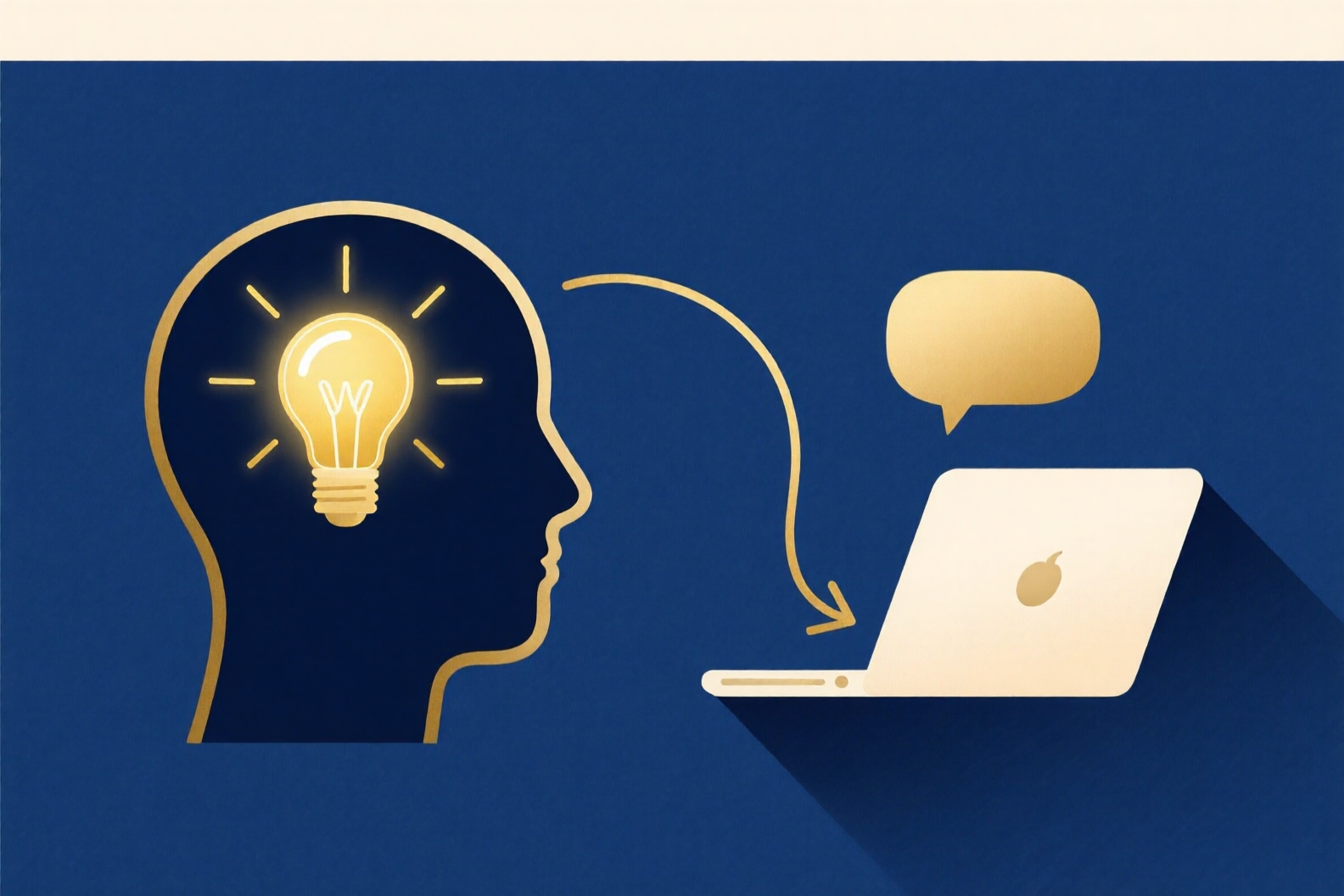
A rule I’d follow: think first, then use AI
- Start with your own draft or your own rough idea, even if it’s ugly. Ten minutes of your own thinking changes what you ask for and how well you can judge the answer.
- Use AI to challenge and extend, not to originate. Ask it what you missed, where your logic is weak, or for three alternatives to compare with yours.
- Keep the judgment calls human. Audience, tone, what matters, and what’s true for your learners are yours to decide.
- Check the output against what you know. If you can’t tell whether it’s wrong, that’s a sign you leaned on it too early.
- Protect some tasks on purpose. Pick a few things you do without AI, the way a runner still runs even though cars exist.
None of this means avoiding AI. I use it every day and wrote about where it earns its place in my workflow. The goal is to keep the part of the work that makes you good at it.
How do you keep your own thinking in the loop when you work with AI? I’d like to hear what’s working.