
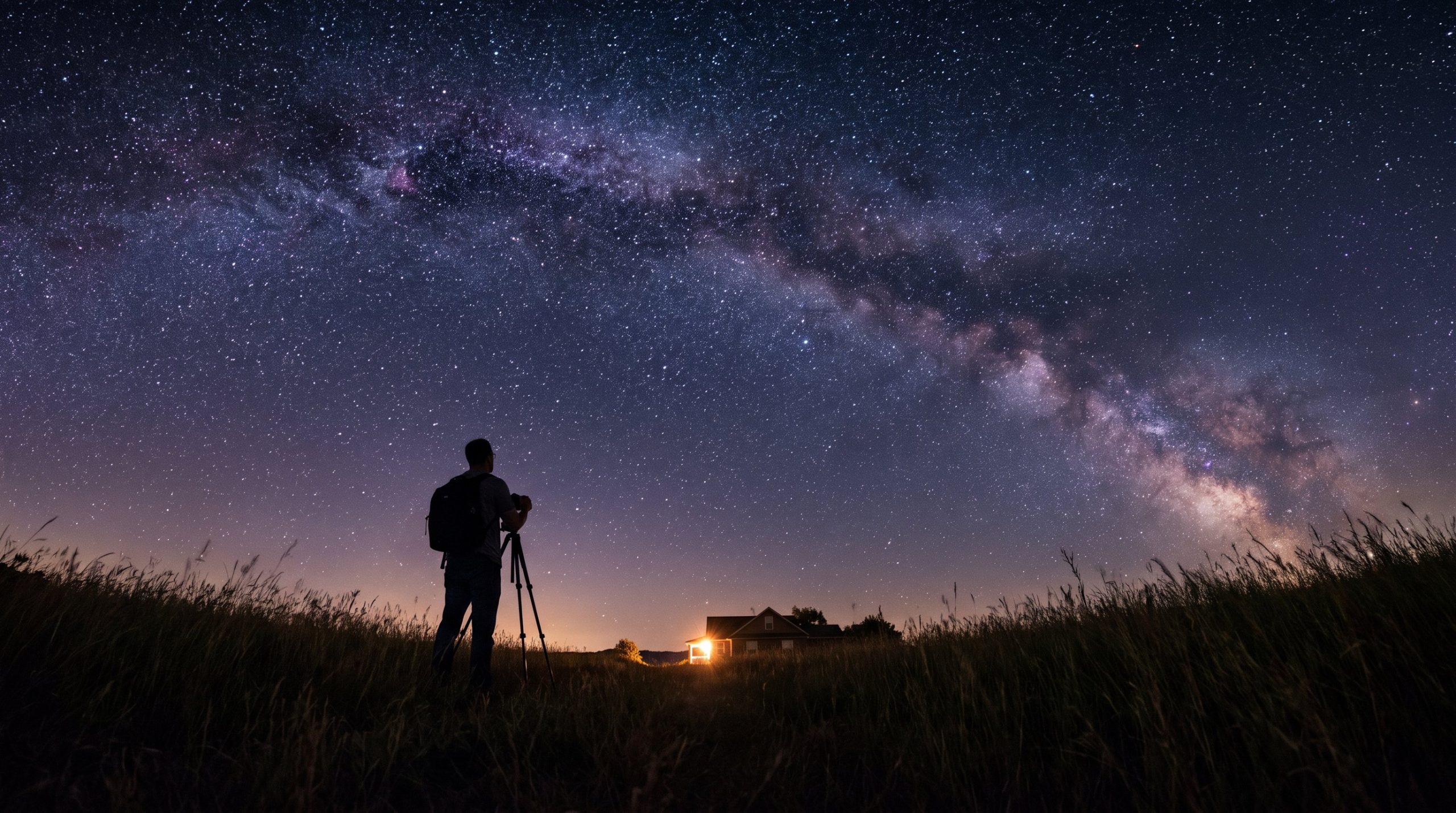
There’s a moment, on any clear night, when the yard work is done and the house has gone quiet, that I find myself just standing there — head back, porch light off — looking up.
It never gets old. Every one of those points of light is a sun. And around more of them than we ever dared to guess, there are worlds. Not metaphorical worlds. Cataloged ones, with names and masses and orbital periods, discovered by people who spent years teasing a planet’s shadow out of a flicker of starlight. Some of those worlds sit in what astronomers call the Goldilocks zone — not too hot, not too cold, where liquid water could pool on a rocky surface. Just right.
I wanted to see them. Not in a spreadsheet — see them. Where they actually are, hanging in the dark around us.
So I built a map.
Start with the real sky
The Goldilocks Atlas is an interactive 3D chart of 115 potentially habitable exoplanets, and everything in it is real. The data comes straight from the NASA Exoplanet Archive — the same catalog professional astronomers use — filtered down to rocky-sized worlds (no gas giants allowed) that receive roughly the same amount of starlight Earth does.
Every planet sits at its true position in the sky. I took each world’s celestial coordinates and distance and placed it in 3D space with Earth at the center, surrounded by distance rings marking 10, 50, 200, 1,000, and 5,000 light-years. Because the distances involved are so absurd — our nearest neighbor is 4 light-years away, the farthest world on the map is thousands — the map uses a logarithmic scale, the same trick your ears use to hear both a whisper and a jet engine.
And here’s my favorite part: the real sky has structure, and the map shows it. Drag the view around and you’ll notice a dense cluster of worlds crowding one corner of the heavens. That’s not a bug. That’s the Kepler field — the single patch of sky NASA’s Kepler telescope stared at, unblinking, for nine years. The map accidentally became a portrait of how we search.
The neighbors keep arriving
The best reason to build this now: the list keeps growing. Nineteen of the 115 worlds on the map were discovered in just the last three years — including a few announced in 2026 that are practically next door. GJ 887 d is 10.7 light-years away. Proxima Centauri d orbits the closest star to our Sun — no world we ever find will be nearer.
Click any world and a dossier slides open: its size, its mass, the length of its year, how much starlight falls on it, and an Earth Similarity Index — a rough score for how much it resembles home. The current champion, Teegarden’s Star b, scores 0.98 out of 1.00. It’s twelve and a half light-years away. On a cosmic map, that’s across the street.
Each dossier also includes a portrait — generated on the fly from the planet’s actual temperature. Cold worlds render icy and blue, temperate ones green, warm ones amber, each lit by the color of its actual star. Nobody has ever photographed these planets; the portraits are honest guesses, painted by physics.
How it was made
Here’s the part that still amazes me as a designer: the entire site is one HTML file. No frameworks, no plugins, no database calls. The 3D engine is written from scratch in plain JavaScript on a single canvas element — projection math, camera controls, the glowing star sprites, all of it. The planet data is baked right into the page, so it loads instantly and works forever, even offline.
I built it in an afternoon, working with Claude (Anthropic’s AI) as a collaborator — pulling fresh data from NASA’s archive, checking the astronomy, and iterating on the design until the thing on screen matched the feeling of standing in the yard at night.
Go look up
Explore the Goldilocks Atlas here. Drag to orbit. Scroll to zoom. Click a world and read its story. Filter down to just the planets found since 2024 and marvel at how fast the neighborhood is filling in.
Then, tonight, if it’s clear — go outside and look up. Somewhere in that dark, 115 worlds are looking back. Statistically speaking, a few of them might even have someone doing the looking.
— Dan, DGS Designs



Related items

Twenty-five years ago today, I was at my desk at a web design agency in Florida. I remembe